

Managing bulk phosphoric acid ISO tank logistics requires strict engineering oversight. Phosphoric Acid (H₃PO₄) is the foundation of high-analysis liquid fertigation, specialty phosphate salts, and industrial food processing. For international chemical importers, industrial blenders, and maritime forwarders, transporting bulk liquid phosphoric acid requires stringent engineering oversight of temperature crystallization points, metallurgical corrosion kinetics, and IMDG maritime protocols.
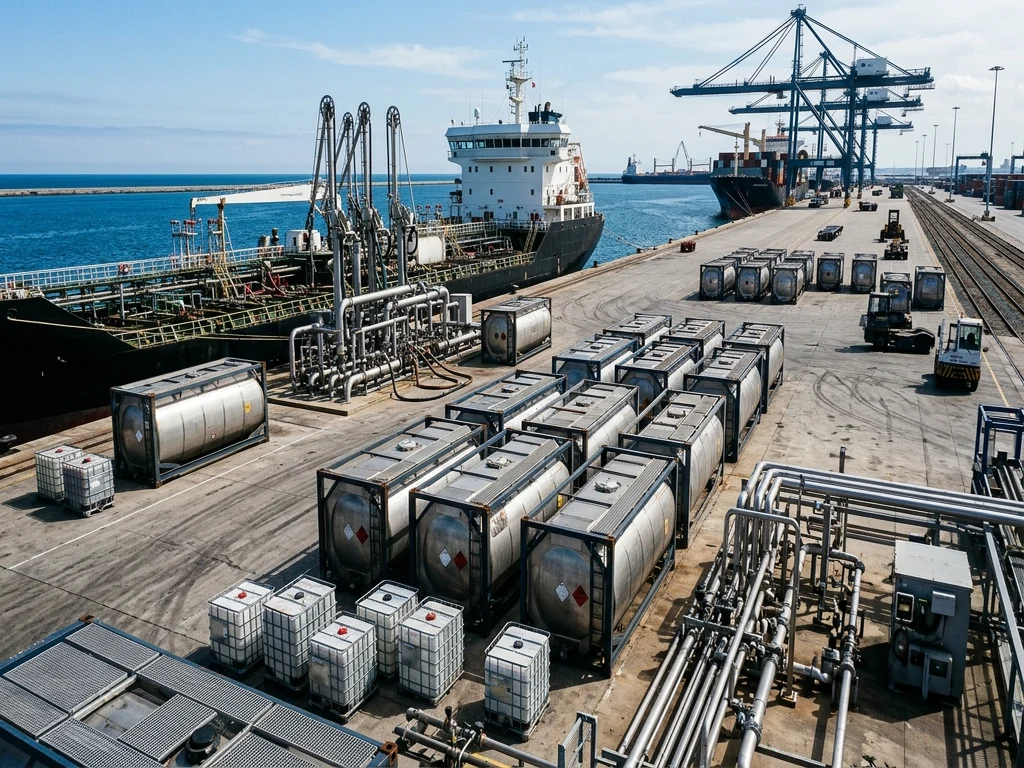
Table of Contents
1. Grade Classifications: 85% Food/Pharma vs. 75% Technical Grade
In high-volume chemical procurement, managing Bulk Phosphoric Acid ISO Tank Logistics requires selecting between 85% food-grade purity and 75% technical-grade agricultural acid.
Bulk shipments generally fall into two primary concentrations, each exhibiting distinct physical behavior during intermodal transit:
| Physical / Chemical Parameter | 75% Technical Grade | 85% Food / Agronomic Grade |
|---|---|---|
| Specific Gravity / Density (20°C) | 1.57 – 1.58 g/cm³ | 1.68 – 1.70 g/cm³ |
| Freezing / Crystallization Point | -17.5°C (Remains liquid in winter) | +21.1°C (Crystallizes at room temperature) |
| Dynamic Viscosity (at 20°C) | 15 – 18 mPa·s | 45 – 50 mPa·s (Heavy, syrupy consistency) |
| Phosphorus Equivalent (P₂O₅) | ~54.3% P₂O₅ | ~61.6% P₂O₅ |
| Typical Heavy Metal Limits (Pb, As, Cd) | < 20 ppm cumulative | < 3 ppm cumulative (Food Codex Compliant) |
2. Bulk Phosphoric Acid ISO Tank Logistics: Temperature & Crystallization Control
A crucial consideration for cargo superintendents is the high freezing point of 85% phosphoric acid (+21.1°C). When maritime vessels traverse North Atlantic or Eurasian waters during late autumn, winter, or early spring, unheated ambient air drops cargo temperature below 20°C, precipitating massive hemihydrate crystals (H₃PO₄·½H₂O). Once crystallized, pumping becomes impossible without thermal remelting.
To eliminate offloading delays, ADENOR Global manages bulk liquid movements using T11 insulated ISO tank containers equipped with integrated low-pressure steam heating channels or electrical heating systems. Port terminals apply dry steam (1.5 – 2.0 bar) to gently warm the bulk container to 30-35°C prior to discharging, liquefying all crystal matrices without thermal degradation.
3. Metallurgy, Gaskets, and Material Compatibility
Material compatibility is a cornerstone of safe Bulk Phosphoric Acid ISO Tank Logistics, requiring 316L stainless steel tanks and virgin PTFE gaskets to withstand corrosive acid action.
Phosphoric acid behaves as a triprotic inorganic acid with aggressive corrosion kinetics against mild steels and standard brass fittings:
- Metallic Contact: Cargo tanks must be manufactured from Grade 316L Stainless Steel (low-carbon with 2-3% molybdenum) or titanium alloys. Standard Grade 304 stainless steel is unacceptable because trace chlorides (>100 ppm) in industrial acid initiate localized pitting and stress corrosion cracking.
- Lining Materials: For multi-year storage or regional transport, carbon steel vessels lined with vulcanized chlorobutyl or bromobutyl rubber (minimum 4 mm thickness) provide exceptional longevity. Polyethylene (HDPE) and polypropylene (PP) are completely inert to phosphoric acid at temperatures below 60°C.
- Gaskets and Seals: Valve packings and manlid seals must be composed of 100% pure virgin PTFE (Polytetrafluoroethylene) or encapsulated FKM (Viton). EPDM and Buna-N rubbers swell and soften rapidly when exposed to hot concentrated phosphoric acid.
4. Regulatory Compliance and Port Safety (IMDG Code UN 1805)
Adhering to IMDG Code Class 8 standards during Bulk Phosphoric Acid ISO Tank Logistics ensures smooth customs clearance and zero demurrage penalties at destination ports.
Liquid phosphoric acid is classified under the International Maritime Dangerous Goods (IMDG) Code governed by the IMO as:
- Proper Shipping Name: PHOSPHORIC ACID, SOLUTION
- UN Number: UN 1805
- Class: Class 8 (Corrosive Substances)
- Packing Group: PG III
- Emergency Response Guidance (EmS): F-A, S-B
Port regulations at Mersin International Port and Izmir Aliağa require continuous secondary containment berms during ship-to-shore hose coupling, hydrostatic pressure testing of transfer hoses every 12 months, and mandatory emergency deluge showers within 15 meters of transfer manifolds.
5. Commercial Bulk Packaging Options from ADENOR Global
ADENOR Global coordinates custom liquid bulk supply agreements under Incoterms 2020 (FOB, CFR, CIF):
- ISO Tank Containers (T11 / UN Portable): 24,000 to 26,000 liters (approx. 38 to 44 metric tons gross weight depending on local road axle regulations). Insulated, 316L stainless steel, fitted with bottom discharge and steam trace coils.
- Composite Intermediate Bulk Containers (IBC Totes): 1,000-liter UN 31HA1/Y composite IBCs (1.6 to 1.7 metric tons per tote), UV-stabilized HDPE bottle with galvanized steel cage, mounted on composite pallets.
- Tight-Head HDPE Drums: 200-liter UN 1H1 certified high-density polyethylene drums (330 kg net per drum), palletized 4 per pallet with heavy-duty stretch film and strapping.
6. Pre-Trip Inspection and Offloading Safety Protocol for ISO Tanks
Executing a disciplined pre-trip inspection checklist ensures that Bulk Phosphoric Acid ISO Tank Logistics operations remain zero-incident from loading terminal to discharge.
Safe discharge of bulk phosphoric acid from intermodal ISO tank containers requires strict operational adherence to international chemical handling engineering:
- Vessel Pressure Depressurization: Prior to uncoupling top or bottom discharge valves, operators must confirm zero internal pressure via calibrated analog and digital dual pressure gauges.
- Dedicated Composite Transfer Hoses: Transfer manifolds must utilize 4-inch PTFE-lined chemical hoses with 316L stainless steel quick-connect camlock couplings, hydrostatically tested to 16 bar working pressure every 12 months.
- Nitrogen Padding & Purging: High-purity food-grade shipments utilize positive-pressure nitrogen blankets (0.3 – 0.5 bar) to isolate the acid from atmospheric oxygen, humidity, and airborne contaminants during multi-modal ocean passages.
Procure Bulk Phosphoric Acid ISO Tank Shipments
ADENOR Global delivers 85% Food/Pharma Grade and 75% Technical Grade Phosphoric Acid in dedicated 24,000L – 26,000L T11 ISO tank containers, 1,000L composite IBC totes, and 200L HDPE drums from Izmir Aliağa and Mersin ports with accredited surveyor verification.