

Ocean transportation and Bulk Fertilizer Maritime Stowage represents one of the highest-volume sectors of global breakbulk logistics. However, hygroscopic materials—including granular urea, ammonium nitrate, diammonium phosphate (DAP), and magnesium and potassium salts—are inherently vulnerable to atmospheric moisture, cargo sweat, caking, and chemical degradation. This guide reviews the engineering standards, hold preparation protocols, and condensation physics necessary to guarantee prime delivery under international maritime charterparties.
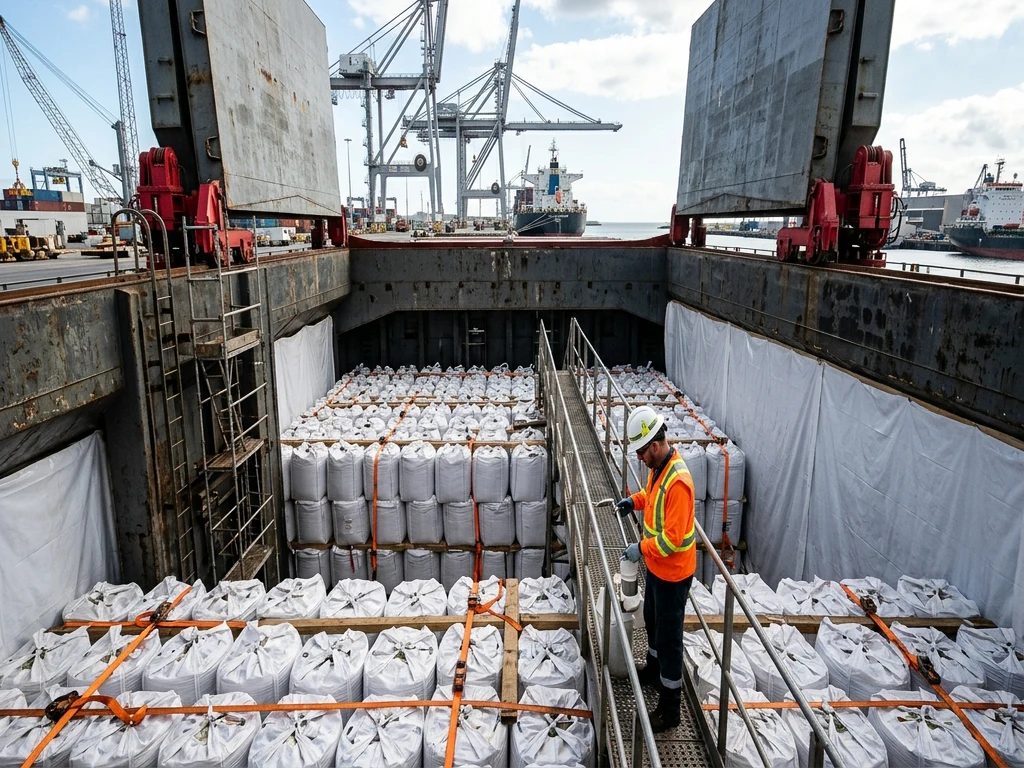
Table of Contents
1. The Physics of Moisture: Critical Relative Humidity (CRH)
In international Bulk Fertilizer Maritime Stowage, monitoring Critical Relative Humidity (CRH) is essential to safeguard granular nutrients against moisture absorption.
Every mineral fertilizer salt has a characteristic Critical Relative Humidity (CRH) at a given temperature. If the relative humidity of the air inside the ship’s cargo hold exceeds the fertilizer’s CRH, the cargo will absorb moisture directly from the atmosphere, initiating dissolution. When the relative humidity drops later during the voyage, water evaporates, leaving recrystallized salt bridges that fuse granules into a solid concrete-like mass (caking).
| Fertilizer Material | CRH at 30°C | Hygroscopic Sensitivity Level |
|---|---|---|
| Granular Potassium Sulphate (SOP) | 84.0% | Very Low (Highly stable in transit) |
| Diammonium Phosphate (DAP) | 70.0% | Moderate |
| Granular Urea (46% N) | 72.5% | Moderate to High (Prone to biuret formation under heat) |
| Ammonium Nitrate (Technical/Fertilizer) | 59.4% | Extreme (Requires climate-controlled handling) |
| Urea + Ammonium Nitrate Mixture | 18.1% | Critical incompatibility (Deliquesces in virtually any air) |
2. Cargo Hold Preparation and IMSBC Code Standards
Rigorous hold cleanliness standards in Bulk Fertilizer Maritime Stowage ensure cargo holds are completely dry and free from rust scale prior to loading.
Vessels carrying bulk mineral fertilizers must comply with the International Maritime Solid Bulk Cargoes (IMSBC) Code administered by the IMO:
- Cleanliness Standard: Holds must meet the “Grain Clean” standard: dry, odor-free, swept clean, free of salt water residues, rust scale, and coal/petcoke dust. Prior cargo contaminants can trigger rapid chemical decomposition or discoloration.
- Bilge Wells Testing: Cargo hold bilges must be sounded, suction-tested, cleaned, and sealed with heavy-duty burlap and marine sealing tape (Ram-Nek) to prevent fine fertilizer dust from entering the bilge piping while allowing drainage in emergencies.
- Hold Lining & Dunnage: For sensitive bagged fertilizers, timber dunnage must be laid across the tank top, overlaid with heavy-gauge polyethylene sheeting (minimum 150 microns) and Kraft paper to form a continuous vapor barrier against hull condensation.
3. Condensation Dynamics: Ship Sweat vs. Cargo Sweat
Disciplined ventilation protocols during Bulk Fertilizer Maritime Stowage protect upper cargo tiers from condensation damage when sailing through differing climates.
The most common cause of fertilizer cargo damage during long ocean passages is condensation caused by rapid temperature transitions across maritime zones:
- Ship Sweat (Vessel moving from warm to cold climates): When a vessel loads warm fertilizer in the Mediterranean (e.g., Mersin Port at 28°C) and sails into Northern Europe or the Baltic Sea (ambient air 5°C), the steel hull plates cool rapidly. The warm moisture-laden air inside the cargo hold hits the icy steel deckhead and frames, condensing into water droplets that rain down on the cargo surface.
Mitigation Rule: Ventilate aggressively with outside air only when the outside air dew point is lower than the hold air dew point. - Cargo Sweat (Vessel moving from cold to warm climates): When a cold cargo travels into warm tropical latitudes, warm humid tropical air must never be introduced into the holds. The warm air will condense immediately onto the cold fertilizer surface, creating severe crusting.
Mitigation Rule: Keep holds completely sealed without mechanical ventilation.
4. Bagged Cargo (FIBC) Bulk Fertilizer Maritime Stowage and Securing
When loading Flexible Intermediate Bulk Containers (1,000 kg – 1,250 kg Big Bags):
- Tier Height Restrictions: Big Bags should not exceed three tiers in standard bulk carriers to avoid crushing the bottom tier and bursting inner polyethylene moisture liners.
- Lashing and Stability: Bags must be loaded tight from shipside to shipside. Empty spaces between bags must be secured with timber shoring or inflatable dunnage bags to prevent cargo shifting during heavy swell conditions.
- Containerized Freight: When shipping in 20ft/40ft dry containers, install heavy-duty 2 kg calcium chloride desiccant poles (absorbing over 200% of their weight in moisture) hung inside container corrugations to mitigate container rain during ocean voyages.
5. Quality Assurance and SGS Inspection at ADENOR Export Hubs
ADENOR Global oversees comprehensive Bulk Fertilizer Maritime Stowage and chartered vessel shipments out of Mersin International Port and Izmir Aliağa with exhaustive quality protocols:
- Hold Cleanliness Certification: Accredited third-party marine surveyors (SGS / Bureau Veritas) conduct pre-loading hatch and hold inspections, issuing official Certificates of Cleanliness before loading commences.
- Draft Survey: Accurate weight determination conducted via calibrated draft surveys in conjunction with the vessel master.
- Karl Fischer Moisture Testing: Continuous composite sampling during conveyor loading to certify that cargo moisture content remains strictly below contract guarantees (typically < 0.3% – 0.5% depending on specification).
6. Standard Charterparty Clauses for Fertilizer Carriage
When chartering Supramax, Handymax, or coaster bulk vessels for full fertilizer cargo stems, commercial commodity traders must incorporate protective charterparty clauses to mitigate moisture and contamination claims:
- Hold Cleanliness Warranty: The charterparty must specify a joint inspection by an independent marine surveyor (SGS, Bureau Veritas, or Saybolt) prior to loading, with the surveyor’s certificate of cleanliness deemed conclusive proof of vessel fitness.
- Ventilation Logbook Protocol: Vessel masters must maintain an hourly log of cargo hold dry bulb, wet bulb, and dew point temperatures, recording all ventilator damper operations to verify compliance with the 3-Degree Dew Point Rule in case of condensation disputes.
- Hatch Integrity Testing: Ultrasonic leak testing (e.g., Cygnus Hatchmaster) or hose pressure testing of cargo hold hatch covers must be conducted and logged before embarking on trans-ocean voyages.
Charter Bulk Mineral Fertilizer Cargoes with ADENOR Global
ADENOR Global coordinates chartered vessel and breakbulk fertilizer exports from Mersin International Port and Izmir Aliağa Terminals under Incoterms 2020 (FOB, CFR, CIF). All consignments include third-party SGS draft surveys, hold cleanliness verification, and Karl Fischer moisture testing.