

In commercial agriculture, optimizing Potassium Nitrate vs SOP fertigation regimes is essential for crop yields. Potassium (K⁺) is the primary osmotic driver of cell turgor, documented by the International Fertilizer Association (IFA), enzyme activation, and carbohydrate translocation. For commercial distributors, greenhouse managers, and fertilizer blenders, selecting between Potassium Nitrate (KNO₃, 13-0-45) and Water-Soluble Potassium Sulphate (SOP 0-0-50+18S) represents a critical trade-off between solubility kinetics, salinity management, and physiological nitrogen timing.
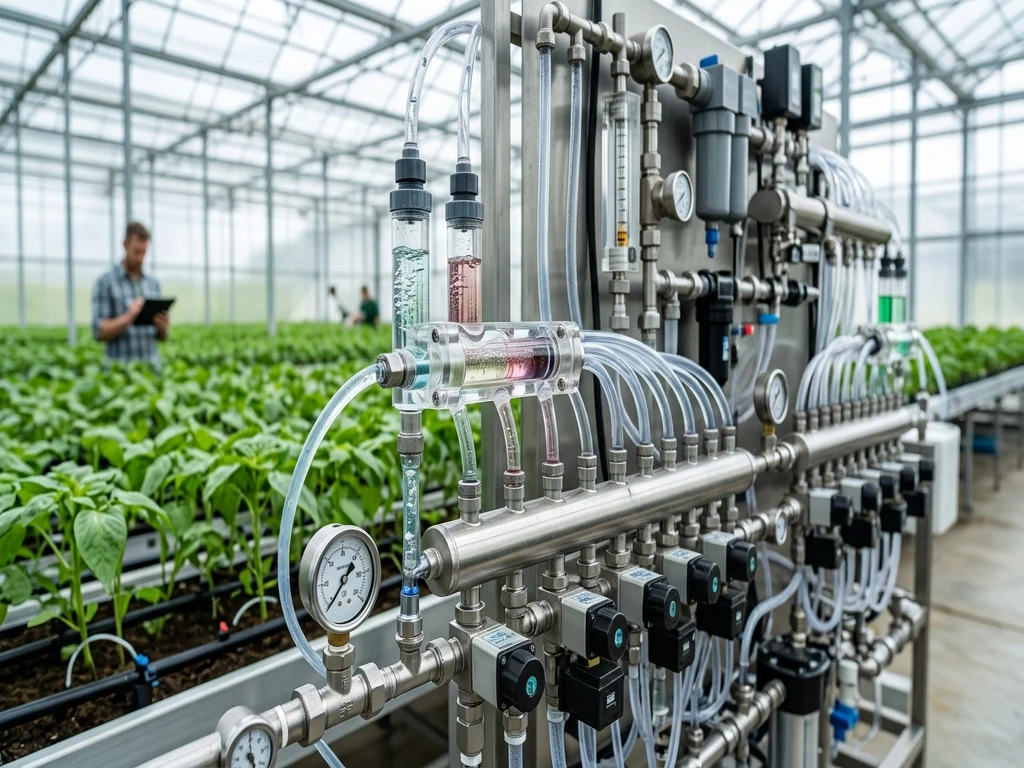
Table of Contents
1. Fundamental Chemical and Agronomic Profile
Both sources provide high-analysis potassium with near-zero chloride content (Cl < 1.0%), making them indispensable for chloride-sensitive crops (such as strawberries, tobacco, stone fruits, and solanaceous greenhouse vegetables). However, their anion carriers—nitrate (NO₃⁻) versus sulphate (SO₄²⁻)—fundamentally alter soil solution dynamics and water absorption.
| Nutrient / Chemical Property | Potassium Nitrate (KNO₃) | Potassium Sulphate (Water-Soluble SOP) |
|---|---|---|
| Nutrient Analysis | 13% N (all NO₃⁻) + 45-46% K₂O | 50-52% K₂O + 17.5-18% Sulphur (S) |
| Solubility at 20°C | 316 g/L (Rapid dissolution) | 110-120 g/L (Requires higher water volume) |
| Salt Index (Partial, Sodium Nitrate = 100) | 73.6 (Moderate) | 46.1 (Lowest among major potassium salts) |
| Electrical Conductivity (EC @ 1 g/L at 25°C) | 1.33 mS/cm | 1.52 mS/cm |
| Dissolution Thermal Response | Strongly Endothermic (Cools stock solution) | Mildly Endothermic |
| Primary Agronomic Stage | Active vegetative growth to early fruit enlargement | Late fruit sizing, ripening, and brix accumulation |
2. Solubility Kinetics in Potassium Nitrate vs SOP Fertigation Heads
In automated drip irrigation dosing units, solubility and dissolution speed directly govern mixing capacity:
- Potassium Nitrate (316 g/L at 20°C): Dissolves cleanly and rapidly, permitting concentrated stock tanks up to 15-20% by weight in warm weather. However, due to its strongly endothermic reaction, dissolving large batches of KNO₃ in cold early-spring water can drop tank temperatures by 6-10°C, temporarily suppressing solubility. Blenders should maintain heated aeration or mechanical agitation during stock preparation.
- Potassium Sulphate (110-120 g/L at 20°C): Has a significantly lower solubility ceiling. Attempting to prepare a 15% SOP stock solution will cause mineral precipitation, emitter clogging, and pump impeller wear. For SOP fertigation, stock concentrations must be capped at 8-10%, requiring larger stock tanks or higher injection flow rates. Only specialized horticultural-grade, fully water-soluble SOP should be fed through drip lines; agricultural granular SOP must never be injected into micro-irrigation lines.
3. Salinity and Physiological Antagonisms
Under saline, arid, or closed-loop hydroponic conditions, the choice of potassium source profoundly impacts root zone osmotic potential:
- Salt Index Dynamics: SOP features a salt index of only 46.1 per unit of K₂O, compared to 73.6 for Potassium Nitrate and 116.3 for Muriate of Potash (KCl). In saline soils or where irrigation water possesses baseline electrical conductivity above 1.5 mS/cm, SOP is the safer carrier to prevent root scorch and water-stress induction.
- Synergistic Anion Uptake: Nitrate (NO₃⁻) is taken up co-transportively with potassium (K⁺), accelerating overall nutrient uptake kinetics during vegetative stages. Conversely, in the final 3-4 weeks prior to harvest, excess nitrogen induces excessive vegetative foliage, delays color development, and reduces post-harvest shelf life. At this juncture, switching from KNO₃ to SOP supplies pure potassium with essential sulfur without introducing unwanted vegetative nitrogen.
4. Tank Compatibility Matrix and Dosing Guidelines
Commercial fertigation systems utilize two-tank (Tank A / Tank B) dosing architectures to eliminate chemical insolubilities:
- Potassium Nitrate in Tank A: Completely compatible with Calcium Nitrate, Magnesium Nitrate, and chelated micronutrients (Fe-EDDHA, Fe-DTPA). No precipitation risks exist across normal operational pH ranges (5.5 – 6.5).
- Potassium Sulphate in Tank B: Must never be mixed with concentrated Calcium Nitrate in the same stock tank. High concentrations of free sulphate (SO₄²⁻) and calcium (Ca²⁺) yield insoluble Gypsum (CaSO₄·2H₂O), permanently clogging drip emitters and dosing manifolds. SOP should always be grouped in Tank B alongside Ammonium Phosphate, Magnesium Sulphate, and Zinc/Manganese Sulphates.
5. Commercial Sourcing and Export Packaging from ADENOR Global
ADENOR Global supplies both technical-grade Potassium Nitrate (13-0-46) and high-purity Water-Soluble Potassium Sulphate (0-0-52+18S) for commercial export from Mersin International Port and Izmir Aliağa Terminals:
- Packaging Standards: 25 kg multi-wall polyethylene-lined bags, shrink-wrapped and palletized (1,000 kg / 1,200 kg pallets), or 1,000 kg UV-stabilized Big Bags with moisture-barrier inner liners.
- Incoterms & Verification: Supplied under FOB, CFR, or CIF Incoterms 2020. Every export consignment is pre-inspected by accredited third-party surveyors (SGS or Bureau Veritas) to guarantee guaranteed solubility, free-flowing anti-caking properties, and certified heavy-metal compliance (Pb, Cd, As < 5 ppm).
6. Commercial Quality Assurance Checklist for Potassium Fertilizer Imports
To safeguard large-scale drip irrigation systems against mineral fouling and emitter blockage, international fertilizer import syndicates must verify rigorous analytical parameters prior to vessel dispatch:
- Turbidity and Insoluble Residues: Dissolving 100 grams of technical SOP or Potassium Nitrate in 1,000 mL demineralized water should yield a crystal-clear solution with turbidity < 5 NTU and insoluble matter strictly < 0.05% w/w.
- Moisture & Anti-Caking Treatment: Moisture content must be maintained below 0.15% at bagging, using biodegradable fatty-amine anti-caking coatings that prevent block-hardening in high-humidity transit without impairing water solubility.
- Heavy Metal Safeguards: Lead (Pb < 5 ppm), Arsenic (As < 3 ppm), and Cadmium (Cd < 2 ppm) certified by accredited third-party surveyors (SGS or Bureau Veritas) to satisfy EU 2019/1009 and global agronomic standards.
Request a Commercial Potassium Fertilizer Export Quotation
ADENOR Global supplies technical-grade Potassium Nitrate (13-0-46) and Water-Soluble Potassium Sulphate (0-0-52+18S) in 25 kg bags and 1,200 kg Big Bags under FOB Mersin/Aliağa, CFR, or CIF Incoterms 2020. Our export shipments undergo comprehensive third-party SGS inspection with full chemical COA documentation.