
In precision drip fertigation and closed-circuit hydroponics aligned with FAO soil fertility and crop nutrition guidelines, high MAP 12-61-0 water solubility makes Monoammonium Phosphate (NH₄H₂PO₄) the industry standard phosphorus source. Its extreme purity, rapid dissolution rate, and natural acidifying buffering action make it superior to conventional phosphate salts. This guide analyzes MAP’s physical dissolution thermodynamics, solution pH buffering chemistry, and tank-mixing protocols for commercial growers and blending facilities.
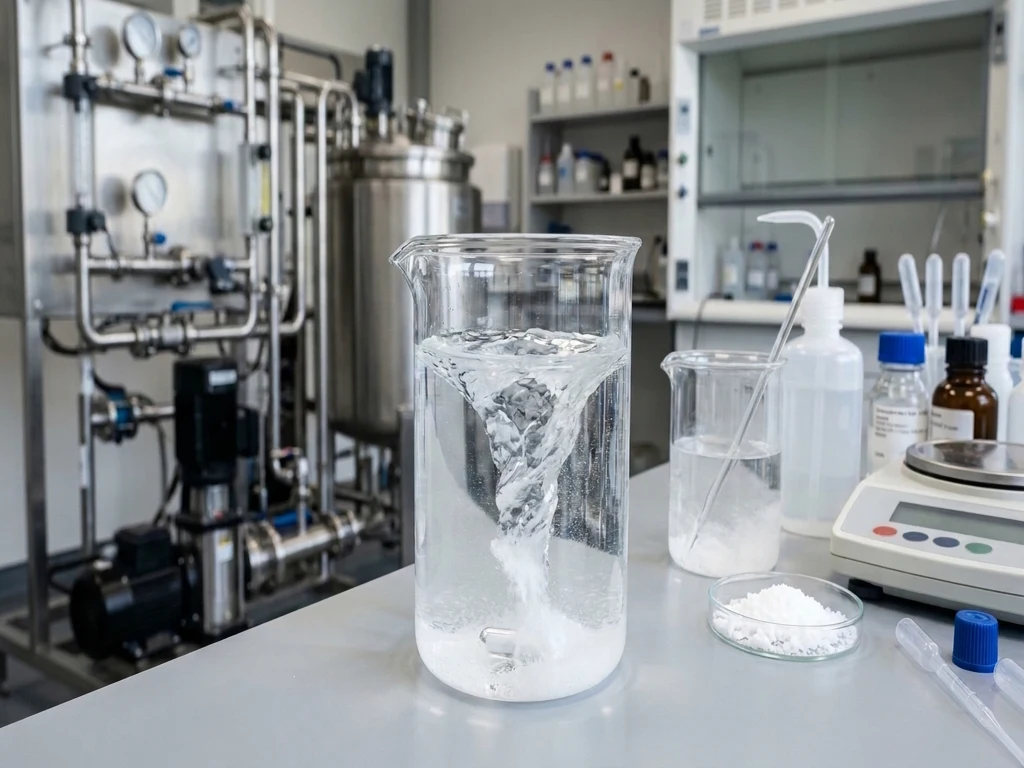
Table of Contents
1. Chemical Composition and Stoichiometric Purity
Understanding high MAP 12-61-0 Water Solubility starts with its precise stoichiometric ratio of 12% ammoniacal nitrogen to 61% water-soluble phosphate.
Technical-grade water-soluble MAP delivers a concentrated nutrient payload:
- Ammoniacal Nitrogen (N-NH₄⁺): 12.0% (Provides readily absorbable nitrogen without increasing root zone nitrate levels excessively).
- Water-Soluble Phosphorus (as P₂O₅): 61.0% (Equating to 26.6% elemental phosphorus, P).
- Chemical Formula: NH₄H₂PO₄ (Molecular weight: 115.03 g/mol).
- pH of 1% Aqueous Solution (20°C): 4.3 – 4.8 (Consistently acidic).
- Insoluble Matter: < 0.05% (Crucial for preventing dripper emitter clogs and filter backwash cycles).
2. Temperature-Dependent MAP 12-61-0 Water Solubility Profile
MAP exhibits an exceptionally favorable dissolution curve, though growers must account for its endothermic dissolution characteristic:
| Water Temperature (°C) | Solubility (g MAP / 1000 mL Water) | Maximum Stock Tank Concentration (% w/w) |
|---|---|---|
| 0°C | 227 g/L | 18.5% |
| 10°C | 295 g/L | 22.8% |
| 20°C (Standard Operating) | 374 g/L | 27.2% |
| 30°C | 464 g/L | 31.7% |
| 40°C | 567 g/L | 36.2% |
Practical Note: Because dissolving MAP draws thermal energy from the solution (endothermic), dissolving 200 kg of MAP in a 1,000-liter tank will drop water temperature by 4°C to 7°C. When preparing concentrated stock tanks during early spring, mechanical agitation or warm water feeds are recommended to accelerate complete dissolution.
3. Buffer Mechanics and Water Conditioning
In addition to rapid nutrient delivery, MAP 12-61-0 Water Solubility provides a natural acidic buffering action that stabilizes alkaline irrigation water around pH 4.5 to 5.0.
One of MAP’s greatest operational advantages is its buffer chemistry. The dihydrogen phosphate anion (H₂PO₄⁻) is an amphiprotic chemical species that stabilizes solution pH between 4.5 and 5.0:
In alkaline irrigation waters containing high concentrations of bicarbonate ions (HCO₃⁻), MAP partially neutralizes alkalinity according to the equilibrium reaction:
H₂PO₄⁻ + HCO₃⁻ ⇌ HPO₄²⁻ + H₂O + CO₂↑
This reaction suppresses free bicarbonate without necessitating aggressive additions of concentrated nitric or phosphoric acid, maintaining trace micronutrients (iron, manganese, zinc) in readily soluble bioavailable forms and preventing carbonate scale buildup on drip emitter orifices.
4. Tank Mixing Matrix: The Tank B Imperative
Agronomists preparing concentrated stock solutions rely on MAP 12-61-0 Water Solubility in Tank B to avoid insoluble calcium phosphate precipitation with Tank A.
In commercial fertigation systems equipped with A and B mother stock tanks, strict chemical segregation must be maintained:
- Tank B (Acid / Phosphate / Sulphate Tank): MAP belongs exclusively in Tank B. It is fully compatible with Potassium Sulphate (SOP), Magnesium Sulphate, Potassium Nitrate, Urea, and chelated micronutrients.
- Tank A Incompatibility: MAP must never enter Tank A containing concentrated Calcium Nitrate or Calcium Chloride. Mixing H₂PO₄⁻ and Ca²⁺ at stock concentrations immediately yields insoluble dicalcium phosphate (Brushite, CaHPO₄·2H₂O):
Ca²⁺ + H₂PO₄⁻ ➔ CaHPO₄ (Insoluble Precipitate) + H⁺
This precipitate forms a hard white sludge that irreversibly blocks dosing pumps, inline disc filters, and drip laterals.
5. MAP vs. MKP vs. DAP: Strategic Selection
| Product | NPK Analysis | Solution pH (1%) | Ideal Agronomic Application |
|---|---|---|---|
| MAP (Monoammonium Phosphate) | 12-61-0 | 4.5 – 4.8 (Acidic) | Early vegetative, root establishment, high-bicarbonate alkaline waters |
| MKP (Monopotassium Phosphate) | 0-52-34 | 4.5 – 4.7 (Acidic) | Flowering and fruit set where zero nitrogen is required |
| DAP (Diammonium Phosphate) | 18-46-0 | 7.8 – 8.2 (Alkaline) | Broadacre soil broadcasting only; unsuitable for precision drip fertigation |
6. Commercial Quality Assurance & Global Export from ADENOR Global
ADENOR Global supplies crystalline, 100% water-soluble Monoammonium Phosphate (12-61-0) to international blenders and greenhouse projects:
- Quality Specs: Moisture < 0.2%, sodium (Na) < 0.1%, chlorides (Cl) < 0.1%, heavy metals certified compliant with European EC 2019/1009 standards.
- Packaging: 25 kg woven polypropylene bags with inner polyethylene heat-sealed liners (palletized and stretch-wrapped), or 1,000 kg UV-treated Big Bags.
- Shipment: Shipped globally in 20ft dry containers (approx. 25-27 metric tons payload) from Mersin and Izmir deep-sea ports with full SGS analytical certificates.
7. Standard Operating Procedure (SOP) for Stock Solution Preparation
Following a standard operating procedure guarantees optimal MAP 12-61-0 Water Solubility without nozzle clogging or sediment buildup in drip emitters.
To eliminate emitter clogging and achieve optimal orthophosphate bioavailability in commercial greenhouse injector manifolds, blenders must follow an exact dosing sequence:
- Water Quality Baseline Assessment: Test incoming irrigation water for electrical conductivity (EC), pH, and bicarbonate (HCO₃⁻) concentration. When water alkalinity exceeds 150 mg/L CaCO₃ equivalent, calculate the acidifying potential of MAP before adding supplemental mineral acids.
- Mechanical Agitation Protocol: Fill the Tank B mother tank to 70% capacity with ambient water. Activate high-shear mechanical agitation before slowly introducing crystalline MAP at a rate not exceeding 50 kg per minute to prevent dense sediment cake formation.
- Thermal Equilibrium Monitoring: Allow 20 to 30 minutes for endothermic cooling to stabilize before reading final stock EC. Maintain stock temperature above 15°C using tank aeration or recirculating heaters in cold winter conditions.
Order Technical Crystalline MAP (12-61-0) for Global Export
ADENOR Global delivers 100% water-soluble technical Monoammonium Phosphate (12-61-0) packaged in 25 kg multi-wall polyethylene-lined bags and 1,000 kg UV-protected Big Bags. Shipped in 20ft container loads (25–27 MT payload) from Mersin and Izmir ports with full accredited SGS quality certificates.